
Tax proposed on L.A. property sales over $5 million to fund homeless housing

In an ambitious effort to address the homelessness crisis in Los Angeles, a coalition of housing advocates, labor unions and progressive activist groups plans to file paperwork Thursday for a ballot measure that would increase taxes on real estate transactions in the city to fund permanent housing for homeless people and those at risk of ending up on the street.

The organizers hope to collect nearly 65,000 signatures by spring to place the tax proposal on the November 2022 ballot.

The measure would levy a 4% tax on property sales above $5 million that would rise to 5.5% on transactions above $10 million. The buyer or seller would owe $200,000 on a $5-million sale, for example.

“This is really about millionaires and billionaires paying their fair share to have a transformative approach to solving our housing crisis,” said Laura Raymond, director of the Alliance for Community Transit-Los Angeles, or ACT-LA, and a leader of the ballot measure coalition.

“This affects folks who are very privileged who have made money off increases in property values, and inequity is one of the reasons why we’re in the situation we are in. So it’s making sure that we’re sort of looking out for each other in protecting our neighbors,” Raymond said.

The coalition said the tax would have applied to about 3% of all property sales in the city from March 2019 to March 2020, generating about $800 million.

The proposed ballot initiative, United to House L.A., could benefit from a recent California Supreme Court ruling affirming that tax increases proposed by citizen initiatives need only a simple majority vote to pass, rather than two-thirds. This ruling was reaffirmed last year and allowed San Francisco to begin spending nearly $300 million a year in business taxes to fight homelessness.

What’s being proposed is known as a documentary transfer tax. The city of Los Angeles already has a similar tax that sends revenue into the general fund, though at a lower rate than what is proposed for the ballot measure. Berkeley, Oakland and Culver City also impose a documentary transfer tax to fund services.

Homelessness will be the dominant issue in Los Angeles elections next year as many candidates vie to replace Mayor Eric Garcetti and compete for a number of City Council seats.

A recent countywide Los Angeles Times poll, conducted in cooperation with the Los Angeles Business Council Institute, found deep frustration over widespread, visible homelessness in Los Angeles. Those voters surveyed showed some willingness to be taxed again to help address the crisis.

By 51% to 41%, voters said they would support a tax increase to “create permanent initiatives to help homeless individuals and reduce the homeless population.” Support increased to 63% if a tax increase included a clear plan to ensure accountability and transparency.

A recent report from the California Housing Partnership found that about 500,000 low-income renters don’t have access to affordable housing in Los Angeles County.

Los Angeles city voters in 2016 approved Proposition HHH, a $1.2-billion bond measure to fund homeless housing. In 2017, county voters passed Measure H, a 10-year, quarter-cent sales tax increase to fund homeless services. Politicians and voters have been frustrated by the slow opening of housing projects funded by Proposition HHH. More than 7,000 units have been funded but construction has been completed on about 1,000 as of last month.

The coalition backing the proposed ballot measure has some two dozen members, including IBEW Local 11, the Inner City Law Center, the Los Angeles Community Action Network and Venice Community Housing.

Some of the groups backing the new ballot initiative were key supporters of both earlier measures, and one of the major supporters of the earlier efforts, the United Way of Greater Los Angeles, is helping craft this measure.

Chris Hannan, executive secretary of the Los Angeles/Orange County Building and Construction Trades Council, said it’s essential that more affordable housing gets built in the city and that can’t happen without more government funding.

“Our members are going to be relied upon to help deliver this housing, and we want to make sure that we’re delivering the housing with good local jobs and really local careers for the community,” he said.

Some in the real estate industry were critical of the tax proposal.

“Increasing more taxes on real estate transactions sends the wrong message as it further increases the already high cost of housing in the region without addressing the core issue — that we are still in a housing production and affordability crisis,” said Stan Smith, president of the Greater Los Angeles Realtors Assn., noting his organization’s support of Measure H.

The revenue from the proposed tax would create more than 26,000 homes for homeless people over the next decade and help about 475,000 renters stay in their homes each year, according to coalition estimates.

About 70% of the proceeds would be spent on various forms of affordable housing.

About a quarter of the total revenue would seek to fund projects through the sale of state and federal low-income housing tax credits, similar to how Proposition HHH works.

About one-third could be spent on turning existing buildings into homeless housing, through purchases, master leases and renovations.

Last year, Los Angeles rented and eventually bought vacant hotels during the pandemic to house homeless people, spending state and federal funds through programs known as Project Roomkey and Homekey.

Most of the remaining money would fund homelessness prevention programs such as right-to-counsel and rental assistance, as well as an inspector general and citizens oversight committee.

Money to help people stay in their homes has been a key response to the pandemic.

“The housing insecurity that we had pre-pandemic was severe, and coming out of the pandemic, whenever that may be, it is going to be even more severe,” said Favian Gonzalez, assistant director of organizing for the tenant advocacy group Strategic Actions for a Just Economy.

The coalition effort is not the only homelessness-related initiative for Los Angeles that could make the November ballot. Mayoral candidate and Councilman Joe Buscaino plans to collect signatures for a ballot measure that would prohibit people from sleeping or camping on sidewalks and other public spaces if they have turned down offers of shelter or emergency housing.

Glen Scher
Why Investors Shouldn't Fear CRE's High Prices

High prices on properties shouldn’t scare off real estate investors, says John Chang, Senior Vice President and National Director Research Services at Marcus & Millichap in a video.

“Just because the price of a piece of property has risen dramatically does not mean its value cannot and will not continue to rise,” said Chang.

What matters, said the Marcus & Millichap expert, is the purchase price today, cash needed to buy, rates and terms for a loan, cash flow today, cash flow in the future and price at time of sale.

“(Investors) should focus on two things: the value of cash flow from that property today and the value of cash flow from a future disposition date, Chang asserted.

The history of the rise and fall in a particular piece of real estate over the last several years is irrelevant, he contended.

Chang noted appreciation has been strong in the last year in a number of property types in commercial real estate. He pointed out year over year the US average increase for multifamily has been 16.1% with 12.7% for retail, 10.9% for office and 21.7 for industrial. In certain cases, there have been huge gains for some markets including a 35.4% hike for multifamily in Phoenix and 32.1% for office in Atlanta.

Chang provided more nuance for investors in an earlier video last month, when he noted that investors would be well-served to consider the three- to five-year supply and demand outlook before snapping up assets.

Consider industrial, an asset class that’s up 22.3% over pre-pandemic levels, with revenues up by 11% and vacancies at a low near 4%. Despite that gap, “investors are purchasing these properties based on rising demand driven by e-commerce and supply chain disruptions,” Chang says. “But even though industrial absorption is at a record level, so is construction, and new development could ultimately bypass demand.”

It’s a similar story for multifamily.

“There’s a lot of speculation that apartment pricing is overheated,” Chang says. “We’re seeing cap rates hit record lows and record high prices in many markets, mostly high population growth areas.”

The average price per unit for apartments nationally is up 11.9% over end of 2019 levels, according to M&M data, but revenues are up by 12.6% and vacancies are at a record low of 2.8%.

Glen Scher
L.A. City Council adopts plan to build 500,000 new homes by 2029

At its final meeting before the Thanksgiving holiday last week, the Los Angeles City Council voted to adopt an update to the general plan's housing element which aims to accommodate the construction of up nearly 500,000 new homes - including more than 200,000 income-restricted units - over the coming eight years.

“The housing crisis is one of the biggest and most pressing issues facing our city,” said City Council President Nury Martinez in a news release. “While other cities have pushed back against their building obligations, our City has embraced this opportunity to develop one of the boldest housing plans in the nation and we hope to not only meet, but exceed, this challenge.”

The framework of the update, named the Plan to House L.A., requires the city to add approximately 57,000 new homes annually between 2021 and 2029 - a five-fold increase from the city's current rate of housing production.  To enable that goal, the plan calls for rezoning broad swaths of the city to create the capacity for more than 200,000 residential units within three years of adoption. 

State law is the motivating factor behind the update.  Under Southern California's new regional housing needs assessment, Los Angeles County is required to plan for more than 1.3 million new residential units over the coming eight years.  The City of Los Angeles will be responsible for a lion's share of that total, with a requirement to accommodate roughly 456,000 new homes (including 184,000 for lower-income households).

Los Angeles, according to data from the 2019 American Community Survey, has the fewest number of homes per adult of any major U.S. City.  The origins of the shortage has been traced to the 1980s, when the city's rising population coincided with scaling back zoning in many neighborhoods, thus limiting the areas in which dense housing could be built.  As a result, housing costs have outpaced income growth, making Los Angeles the most rent burdened and overcrowded major city in the country.

But in addition to a simple calculation of supply and demand with regards of housing, planners must also negotiate a legacy of land use decisions where impacts have fallen squarely on communities of color.  In a more than five-hour hearing held on October 13, Planning Department officials noted that Los Angeles, despite its much-touted diversity, is also highly segregated. 

Neighborhoods in the Westside, Northeast Los Angeles, and large swaths of the San Fernando Valley are associated with higher educational attainment, income, life expectancy and economic mobility relative to the city as a whole.  These higher-resource communities have seen fewer housing developments than other underresourced areas of the city.

At the same time, studies have found the white residents have by far the greatest access to those high-resource neighborhoods, whereas roughly 1 in 4 Black and Latino residents live in high-poverty areas. Likewise, high-poverty and majority-minority neighborhoods in Central and South Los Angeles have carried the burden of affordable housing production for the region as a whole.

To counter these historic patterns, the updated housing element places high-resource areas front-and-center for the proposed zone changes, while also including anti-displacement strategy studies, eviction defense programs, and considerations for potentially adopting inclusionary zoning.

Adoption by the City Council is not the final step in the process, however. The housing element update is also subject to review and certification by the California Department of Housing and Community Development. 

While the housing element establishes targets and overarching policies for housing development in the City of Los Angeles, the actual implementation of the zone changes require to meet state targets will be set out through separate pathways, such as the community plan updates and affordable housing incentive programs like the Transit Oriented Communities guidelines.

Glen Scher
Canada's inflation rate soars to almost 20-year high, raising odds of earlier rate hike

Inflation is nearing its fastest pace since the Bank of Canada began using the consumer price index to set interest rates in the early 1990s, increasing the odds that the central bank will raise borrowing costs early in the new year.

The CPI surged 4.7 per cent in October from a year earlier, compared with a year-over-year gain of 4.4 per cent in September, Statistics Canada reported on Nov. 17. The CPI also increased 4.7 per cent in February 2003, which had stood alone as the biggest increase since a 5.5 per cent gain in October 1991, a moment when the Bank of Canada was nearing the end of a successful fight against a wave of price increases that peaked around seven per cent earlier that year.

Back in 2003, when annual CPI increases neared five per cent, then governor David Dodge opted to raise interest rates the following month, observing in a statement that “persistent above-target inflation rates over the past few months reflect not only the impact of higher-than-expected crude oil and natural gas prices, but also continuing increases in auto insurance premiums and price pressures in certain sectors such as housing, food and some services.”

The same could be said of current conditions. October marked the seventh month in a row that headline inflation ran hotter than three per cent, the high end of the Bank of Canada’s comfort zone, while year-over-year increases in the CPI exceeded three per cent for six consecutive months through March 2003. Now as then, the main sources of upward price pressures are crude, natural gas, housing, food and some services.

Yet what to do about inflation remains a dilemma for Bank of Canada governor Tiff Macklem despite the alarming jump in the CPI, because various labour-market indicators suggest the economy remains weak, justifying the benchmark interest rate’s current setting of 0.25 per cent. The biggest driver of the CPI’s latest surge was a 42 per cent increase in gasoline prices, which are being stoked by a severe mismatch between supply and demand in global energy markets. There’s nothing the Bank of Canada can do about that.

In theory, cost increases that are the result of shortages of inputs such as oil and computer chips should subside as suppliers rush to fill demand. Therefore, the best cure for current conditions is probably patience.

“While our analysis continues to indicate that these pressures will ease, we have taken them into account for the dynamics of supply and demand,” Macklem said in an op-ed published by the Financial Times earlier this week. “What our resolve does mean is that if we end up being wrong about the persistence of inflationary pressures and how much slack remains in the economy, we will adjust.”

Subtract energy from the CPI basket of goods and services and the increase from October 2020 was 3.3 per cent, the same year-over-year gain that was posted in September, Statistics Canada said. That’s still hotter than the Bank of Canada would like, but suggests that underlying price pressures probably aren’t as severe as the headline number makes them out to be. The average of three measures of “core” inflation that the Bank of Canada follows to assess price trends was 2.7 per cent, a reading that falls within the central bank’s comfort zone for inflation of one per cent to three per cent.

“Changes in domestic monetary policy — although arguably important for signalling reasons — won’t alleviate inflation pressures that are global in nature,” Karl Schamotta, chief market strategist at Cambridge Global Payments, said in an email to clients. “Ebbing supply chain issues, falling commodity prices, and lower levels of fiscal support are likely to prove more important over the year ahead.”

Macklem would look through the recent burst of inflation if not for concern about what the outsized readings will do to expectations of where prices are headed. He and his deputies last month opted to end their bond-buying program and advance by three months their timeline for their first post-pandemic interest-rate increase. The main reason for those moves was to keep inflation from becoming a self-fulfilling prophecy, whereby workers start demanding higher wages and suppliers begin raising prices in anticipation of permanently higher costs.

That’s a legitimate concern. All the major components of Statistics Canada’s CPI basket increased in October, led by a 10 per cent jump in transportation costs, which capture energy prices. Shelter costs increased 4.8 per cent and food costs rose 3.8 per cent from October 2020. Both those gains were roughly the same as the previous month.

“The recovering economy and hot inflation will likely prompt the Bank of Canada to react and raise interest rates sooner rather than later,” said Ksenia Bushmeneva, an economist at Toronto-Dominion Bank. “We expect the Bank of Canada to start raising its key interest rate in April of 2022, but cannot rule out the possibility the central bank will act earlier if the job market remains resilient and inflation keeps surprising to the upside.”

Glen Scher
US Property Price Growth Breaks Records as Demand Swells

The headline rate of U.S. property price growth climbed to the fastest annual rate in the history of the RCA CPPI in October amid intense investor demand for commercial real estate. The RCA CPPI National All-Property Index rose 15.9% from a year ago and 1.7% from September, the latest RCA CPPI: US report shows.

For the year through October, investors acquired $523.8 billion of commercial property assets, a 70% increase on the same period in 2021, as shown in the US Capital Trends report, also released this week.  Investors spent more than $200 billion on apartment properties in the first 10 months of 2021, almost double the activity seen at this point in 2020, and more than $100 billion on industrial properties.

Industrial prices rose 18.9% in October from a year ago and 1.9% from September, the fastest annual and monthly rates among the major property sectors. The apartment index climbed 16.8% from a year ago, the fastest rate in the history of the RCA CPPI for this sector. Apartment prices rose 1.4% from September.

The office index increased 13.7% year-over-year in October, a fourth consecutive month of double-digit growth. Suburban office prices continued to drive gains, increasing 15.6% from a year prior. The CBD office index rose 0.9% year-over-year, an improvement from the declines seen for most of 2021.

Glen Scher
Here Are the Apartment Markets Attracting New Renters

Remote work continues to dominate renter migration patterns, according to data released this week by Apartment List—particularly in tech-hub markets such as San Jose, Raleigh, and Austin.

Dramatic rent increases have hit virtually all corners of the nation in 2021. Nationally, the median rent price is up over 16% since January, and in some cities rent growth is more than double that, Apartment List reported.

“Today, renters who are looking to move are not only dealing with this affordability crunch, but also navigating a tight market with historically low vacancy rates,” according to the report. “At the same time, migration patterns are also being impacted by one of the most significant societal shifts brought about by the COVID pandemic—remote work.”

Top Three ‘Revolving Door’ Markets

San Jose, Raleigh, and Austin are experiencing high turnover with many renters considering moving both in and out.

These three “revolving-door” metros are the only places that appear in the top 10 for both metrics. In San Jose and Raleigh specifically, the cross-metro rate exceeds 50% for both outbound and inbound searches. 

These regions stand out as technology hubs heavily disrupted by the remote work revolution. In fact, they rank first (San Jose), fourth (Austin), and eighth (Raleigh) in terms of the share of their workforce that have remote-friendly occupations. 

This quarter’s report incorporates the search preferences of users who registered with Apartment List between July 1 and Sept. 30, 2021.

“Newfound flexibility has likely given many residents of these three metros the opportunity to move somewhere new, which in turn creates vacancies that attract new renters from afar,” Apartment List reported. “We have seen this dynamic play out in local rent prices, where over the last 18 months these cities experienced dramatic rent declines followed by similarly-dramatic rent rebounds as residents cycle in and out of the rental market.”

Beyond these three, other technology-friendly markets that are experiencing high outbound migration this quarter (e.g., San Francisco, Boston, Denver, Baltimore) also rank high in terms of remote-friendly workforces and dramatic price swings.

Long-Distance Moves on the Increase

This collision of market trends and changing preferences may result in a greater number of longer-distance moves—in Q3 2021, 40% of Apartment List users were searching to move to a new metropolitan area, and 26% were searching in a different state altogether. 

Despite being separated by more than 1,000 miles, Miami is the number one destination for New York City renters, narrowly edging out nearby Philadelphia. 6.1% of searches leaving the New York City metro are destined for Miami, and another 7.8% are destined for other parts of Florida, namely Tampa, Orlando, and Jacksonville metros.

California: A Major Exporter of Renters

As a large, expensive, and politically liberal state, California has long held a reputation for exporting residents across the country and altering economic and political landscapes along the way. This notion hit a major milestone in 2020, when for the first time in its 170-year history California experienced net population loss, losing over 182,000 residents in the wake of the COVID-19 pandemic. 

Apartment List search data indicate that this trend may be continuing, as California supplies more search interest across the country than any other state. In the most recent quarter, eight states—Alaska, Hawaii, Washington, Oregon, Nevada, Arizona, Utah, and Texas—received more searches from California than any other state. In Nevada specifically, over half of all apartment searches came from California residents.

Glen Scher
STUDY: Cities With Anti-Airbnb Laws Saw Less Housing Development, Lower Property Values

An unregulated short-term rental market has been proven to drive up the cost of big-city housing, but a new study shows that restrictions targeted at Airbnb have a chilling effect on residential development.

The paper, titled "The Effect of Short-Term Rentals on Residential Investment" and co-authored by researchers from real estate data firm Cherre, McGill University, the University of Southern California and Cal State University, Fullerton, was published in Harvard Business Review Wednesday

The researchers found that in 15 U.S. cities that have passed laws restricting short-term rentals, including New York City, Los Angeles, Boston, Denver and Austin, new residential permits fell in correlation to new Airbnb listings. Property values have lost roughly $3B annually across those markets, the researchers found, leading to $40M a year in lost tax revenue.

"We demonstrate that home-sharing increases residential investments by boosting the demand and the value of residential housing," the researchers wrote. "Specifically, we show that home-sharing regulations lead to reduced house prices."

Before restrictive legislation, a 1% increase in Airbnb listings led to nearly a 0.8% increase in residential development permits across 15 cities, the study found. But when regulations were put in place, listings fell 21% and permits fell 10%. 

The regulations in cities around the countryaimed at curbing STRs' effects of reduced housing supply and higher rents and home prices amid an affordability crisis, did push the cost of housing down, but cut city revenue and economic development in the process. 

“This is not to suggest that unregulated growth is the answer,” the researchers wrote in HBR. “But our research illustrates that with the right policy approach, STRs can be leveraged as a tool to encourage local real estate development and economic growth.” 

The authors noted that housing affordability is a key factor to consider in writing future restrictions, as is the community investment that would come from bolstering revenues. 

“Rather than enforcing blanket restrictions that hinder growth, we recommend creating targeted policies that meet local needs,” the researchers wrote. “As development spurs growth, policies could be implemented that would set aside a portion of the resulting increased tax revenue to fund affordable housing for local residents. Similarly, to address gentrification concerns, the total amount of space available for STR use could be capped at a percentage of available housing capacity, thus encouraging the development of long-term housing alongside STRs.” 

Glen Scher
Downtown LA Leads Nation in Apartment Production

The multifamily boom in Downtown Los Angeles has been well-documented, but now we have the numbers to put it in perspective with other urban neighborhoods around the country.

Approximately 1.6 million new rentals were added throughout the country in the last five years. Listings and research site RENTCafe analyzed construction data for the 50 largest cities and compiled the top 20 most active neighborhoods, which alone produced 80,000 new rental units in that time. And Downtown L.A.’s impact stood clearly ahead of the pack. 

Between 2017 and 2021, the urban hub on the eastern end of the city drew 10,136 multifamily units, which accounts for 39 percent of the total new apartments added to L.A.’s supply in that time. It’s also nearly twice as many as the neighborhood that produced the second-most in the U.S., which is Midtown Atlanta with 5,936 units.

In the past five years, Downtown saw Greenland USA finish the 6.3-acre Metropolis development, which alone added more than 1,500 residences. Also, Holland Partner Group built The Griffin and The Grace — two 24-story buildings with approximately 580 units in the Fashion District.

RENTCafe’s top 20 list also includes Hunters Point in Queens, N.Y., which came in third with 5,423 units, as well as the Navy Yard in Washington, D.C., which came in fourth with 4,953 new units.

Hollywood was 10th after adding 3,431 units in the past five years. The neighborhood was slow to change throughout the 1990s and 2000s, but residential development has taken off in the last decade.

The influx of units hasn’t done much to ease the demand from renters and investors. Apartment rents and multifamily sales prices both hit record highs over the past year in Southern California, and earlier this year, the average rent in L.A. County returned to and exceeded pre-pandemic heights.

Glen Scher
Weinreb Holdings Sells Adjacent Apartments in Northridge

Investor Pays Nearly $15.3 Million for 59 Units

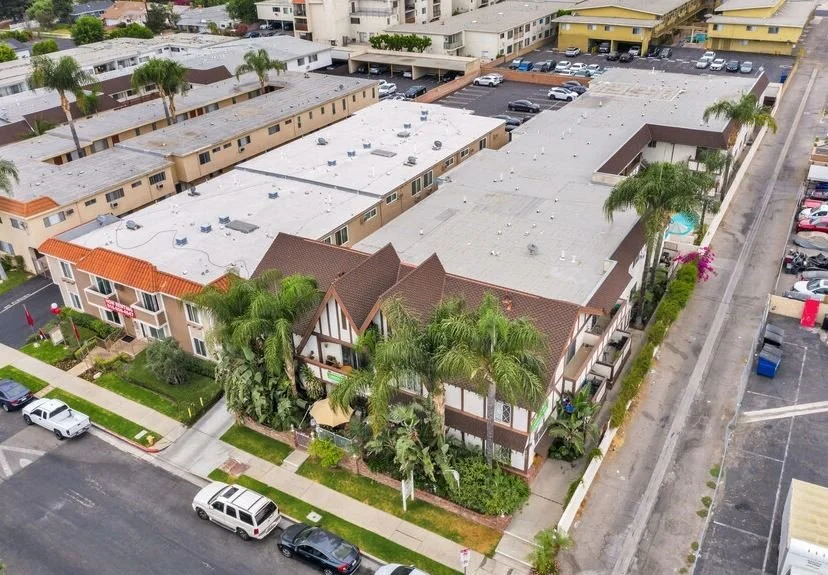
A private investor acquired the Northridge Villa apartments at 18521 Prairie St. and the adjacent Majestic Prairie apartments at 18561 Prairie St. in Los Angeles, California.

Weinreb Holdings sold the 59-unit, 45,015-square-foot multifamily portfolio for $15.25 million, or more than $258,000 per door.

The properties offer a swimming pool, fitness center, gated entrance, covered parking and laundry facilities.

Filip Niculete, Glen Scher and Makan Mostafavi with Marcus & Millichap the buyer. Niculete and Scher also represented the seller in the deal.

Please see CoStar COMPS #5702297 for more information on this transaction. 

Glen Scher
Hessam Nadji: Office Investors Still Scouting Opportunities

However, tenants and owners alike are “still trying to figure out what happens” beyond the next six months, and most are expecting less demand in the short term.

Commercial real estate investors are still interested in the office asset class in this low-interest rate environment. 

“The investment market is looking beyond this current cloud,” Marcus & Millichap CEO Hessam Nadji told CNBC’s ‘Squawk on the Street’. 

The industry is aggressively scouting investment opportunities, he says, as more than $5 trillion in excess capital will eventually get released into the market.

“Even buyers of office space—they’re not out of the market,” according to Nadji. “They’re in the market, taking advantage of low interest rates way ahead of the recovery in every property type.”

Nadji told CNBC that tenants and owners alike are “still trying to figure out what happens” beyond the next six months, and that most are expecting less demand in the short term. But as the economy recovers and new business formation picks up, Marcus & Millichap foresees a new expansion of space demand: “There should be an offset behind the current delay”, he said.

Boston, Austin, Nashville continue to stand out as cities posting the strongest office demand, while New York City, Washington DC and Chicago are among the weakest metros. But Nadji says much of these differences—which he says are actually quite small in most cases—depend on factors like the size of the metro’s central business district, the amount of public transportation, and the nature of the office-using jobs. 

“We’re seen a lot of improvement in New York and in other lagging markets…it’s just that they had a bigger problem to solve because the pandemic had a larger impact on a bigger market,” Nadji said.

Going forward, he predicts everyone—whether employers or employees—will want plenty of in-office time for collaboration and team interaction. The need for collaborative space is already overshadowing demand for individual offices and cubicles, so the use of space is being re-envisioned. 

On top of that, “the hybrid notion is a lasting strategy,” he said. That spells a return closer into CBDs: “If you’re coming into the office three days a week, you’re going to need to be fairly close,” Nadji told CNBC.

Glen Scher
Five Ways Pandemic-Inspired Drinking Laws Could Shake Up Commercial Property

Drinks Could Become Fixtures in Drive-Thrus and at Outdoor Tables in Mall Parking Lots

Officials around the country are considering whether to make permanent the looser drinking laws passed to help bars and restaurants stay open in the pandemic. That means more cities could be allowing carryout margaritas or self-serve beer and wine taps. And along with local food courts could come booze courts.

When the pandemic shut bars and restaurants nationwide, state and local governments stepped forward to bend long-standing licensing and other commercial property use rules. That cleared the way for carryout cocktails and the sight of diners sitting at tables in the middle of a mall parking lot or a once-busy street that had been closed to traffic.

Now California is poised to make these alcohol-related policies permanent, and other states and cities are mulling their own versions of long-term, relaxed restrictions designed especially to help smaller independent restaurants still struggling to rebound from pandemic closings and indoor capacity restrictions. The effects on commercial development could be considerable.

“These changes that made it possible to serve drinks in public parklets or order cocktails for takeout are probably going to become more permanent in some types of projects,” said James Cook, Americas director of retail research for brokerage JLL. “It could give some property owners a lot more flexibility in determining the right mix of commercial elements based on the type of property, the location, seasonality and other factors.”

Here are five ways shifting alcohol-serving logistics could affect the way commercial projects are configured, approved and ultimately patronized by customers.

1. Drinks From Drive-Thrus and Self-Serve Taps

Carryout sales of high-margin margaritas, daiquiris and other mixed drinks proved crucial to many restaurants in the early months of the pandemic. Permanently relaxed alcohol restrictions could give restaurant developers and operators new ways to turbocharge those sales while lowering costs in a low-margin industry.

“In states where alcohol consumption off-premises has been relaxed, very likely we will see liquor delivered through the drive-thru and to take away with food,” said Darren Tristano, CEO of industry consulting firm FoodserviceResults. In regions such as Miami, he said, Taco Bell and other fast-food restaurants have already begun adding beer, wine and other alcoholic beverages to their menus.

“In some cities like New Orleans, you can purchase adult-beverage drinks through the drive-thru,” Tristano said. “I think we will see more of these types of operations if operators believe that this legislation is more permanent than temporary.”

Self-serve beer and wine taps, which began appearing in bars and restaurants before the pandemic, could become more common, especially as operators struggle to find workers. It’s the alcohol version of those frozen yogurt shop spigots, with taps popping up at many bars and restaurants equipped with technology that measures the pours and automatically charges a customer's credit card.

“The automated and self-serve liquor bars will likely do better based on labor savings, especially since labor today seems to be a very hot commodity and in short supply,” Tristano said. “Ultimately, a hybrid model which incorporates some automation and some live bartender/mixologists will likely be a better scenario as many patrons still wish to order from a live person.”

2. Drinks Carried Through Strip Malls

Lawmakers in the most populous state could clear the way for beer gardens and booze courts. The sharing of common outdoor spaces for serving and consuming alcohol could face fewer prohibitions as part of the recently passed California Senate Bill 314, put forward by San Francisco Democrat Scott Wiener. It's expected to get a final vote in the state Assembly this month.

The state has allowed shared outdoor drinking spaces in the pandemic, and it would become long-term policy effective Jan. 1 if it is signed into law by the governor. These shared-space allowances would be permanent for businesses getting a liquor license before July 1, 2024, when the program is scheduled to expire or otherwise be considered for an extension.

“I think this especially could make a difference for something like an open-air ‘lifestyle’ center, where you have a lot of common spaces that aren’t being fully used for permanent business uses,” JLL's Cook said.

Restaurants and bars in mixed-use centers, for instance, could establish permanent outdoor extensions of their indoor operations, but let customers carry alcohol to other areas, including patios of other businesses on the same private commercial property.

Special events held in common areas might let visitors bring alcohol bought at any of a retail center’s tenants to mingle in the same space, though Cook said they may need to mesh with local regulations.

3. Public Walking-and-Drinking Zones

Common areas could expand beyond private commercial property to public areas. Changes brought by the pandemic have spurred cities in California, Colorado and other states to rethink policies that tightly restrict the carrying of open alcohol containers along streets and sidewalks and in parks. While most are not ready to liberalize policies along the lines of party-centric cities like Las Vegas and New Orleans, some are considering allowing walking while drinking on a limited basis in designated and regulated areas.

Denver has been testing the concept of public common consumption zones for several years, and in June it began allowing businesses with alcohol licenses to apply for a program letting them cluster to allow customers to move freely indoors and outdoors with drinks beyond private commercial property.

Cook said other U.S. communities could follow suit with rules that reflect local preferences. According to Denver’s Department of Excise and Licenses, for instance, consumption zones cannot be larger than 100 acres, and customers cannot use glass containers out of concerns for safety and litter control.

Steve Avoyer, president of brokerage Flocke & Avoyer Commercial Real Estate, said the consumption zone concept could be a good fit for numerous mixed-use entertainment districts now being planned at or near sports arenas in San Diego, Anaheim, San Francisco, Oakland and cities outside of California. The idea is to give neighborhoods a commercial development boost similar to the parking lot tailgating that takes place in stadium parking lots before and after games, but in a more regulated, year-round fashion.

4. Beer-Themed Hotels

While some of these projects were conceived before the pandemic, Cook said the newly relaxed approach to alcohol in public settings could lead to creative formats like a beer-themed hotel opened earlier this year by Scotland-based craft beer maker BrewDog in Columbus, Ohio.

BrewDog’s website touts the Doghouse Hotel & Brewery as the world’s first craft beer hotel, “where you can wake up inside a brewery” to the smells of fermenting hops and yeast. The 32-room hotel also has a fitness center, dog-friendly rooms and a craft beer museum.

There are already signs that craft beer makers are looking to move beyond industrial parks to raise their profile in high-traffic retail settings. BrewDog has reportedly taken out city permits as it plans a 30,000-square-foot rooftop complex at the existing Showcase Mall on the Las Vegas Strip.

5. More Pushback on Projects

There's a big caveat to all the talk of looser alcohol restrictions: opposition from nearby residents who don't want their neighborhoods turned into a big tailgate party or mini-Mardi Gras. This type of concern could generate more vetoes on commercial projects, industry professionals say.

Opposition could come not only from residents opposed to noisier and drunker open-air partying, but also from nearby non-alcohol-serving businesses not looking for problems from fellow tenants.

This reluctance by permitting officials could come as the economy improves and retail center tenants are generally less desperate for foot traffic.

“At some point tenants in some projects might say, ‘Hey, I want my parking spaces back,’ or ‘I don’t want drunk people wandering from these other businesses and disturbing the customers in my store,’” Avoyer cautioned. “Overall, I think the idea of these public outdoor spaces where alcohol can be served is a good one — they have them in many European cities and they don’t cause concern most of the time.”

“But you’re going to need some constant on-site enforcement by the property owners at first if you want to avoid fallout from neighbors,” he added. “I think that over time as these kinds of projects are accepted and the problem tenants are weeded out, this could become a normal kind of thing in a retail setting.”

Glen Scher
How Lenders Are Underwriting Post-Pandemic Apartment Deals

Rent collections and future rent growth are the biggest concerns for Liberty SBF on new multifamily deals.

The pandemic may not totally be in the rearview mirror, but the economy is already starting down the path toward recovery. As lenders start to examine apartment deals in the early days of the post-pandemic era, there are still a handful of uncertainties informing the underwriting process. Rent collections are at the top of that list, and that picture isn’t as bad as some feared, Alex Cohen, CEO of Liberty SBF, tells GlobeSt.com.

“During the pandemic and in the early days of the post-pandemic era, collections have been okay,” Cohen notes. “Collections are still improving, and I don’t think that we saw the collections issues that were anticipated. With that being said, a lot is a direct result of stimulus dollars being pumped into the system along with support legislation, which has helped renters keep up with collections. In many municipalities, that has kept collections up.”

In the first six days of August, only 80.2% of renters made a full or partial rent payment, according to data from the National Multifamily Housing Council. It’s an improvement over the last several months of rent collections, and the highest rate since March. It also shows that collections still haven’t returned to pre-pandemic levels.

Cohen is interested to see how the end of stimulus money and eviction moratoriums will impact rent collections later this year and into 2022.

Reduced rent collection is largely a problem in expensive, dense urban markets. These cities have also seen a sharp decrease in overall rental rates, although that has now stopped. “We still have a lot of markets where there is a lot of under performance. Nationally, year-over-year rent growth is around 10%. We have been concerned about certain markets, specifically Downtown urban environments like New York City and San Francisco, where rents were hit particularly hard but are now showing some uptick. We have been watching those areas,” says Cohen. “There are challenges in some of these larger cities, but we still think there is value there as asset values have depressed.”

Second-tier markets and the Sunbelt are another story. Through the pandemic, Sunbelt metros, smaller cities and class-B and class-C product outperformed the big cities and luxury buildings. However, in the post-pandemic era, Cohen expects the growth to slow. “We are scrutinizing proformas pretty closely,” he says. “We are underwriting to current rents in some of these smaller markets. We do see these markets are performing. For instance, in Jacksonville and Memphis, where Liberty is transacting, CoStar recently reported year-over-year rent growth of 20% and 12.6%, respectively. I think that it will be hard to justify rent growth at the same pace that we have seen.”

While Liberty is underwriting conservatively as it waits to see how rent collections and rent growth play out, it is confident in the strength of the asset class. “There are interesting projects across the country, and we do expect the asset class to continue to perform,” says Cohen. “It may not see the type of rent growth that we have seen, but we do expect it to perform given the under supply. At the end of the day, when a project makes sense from a pure value standpoint, that is when it is more interesting to us.”

Glen Scher
'A longer road to recovery'

Canada's economy shrinks, catching economists by surprise

Canada’s economic recovery lost momentum in the second quarter after posting consistent growth since the depths of the pandemic and delivered a shock to forecasters.

The economy contracted 0.3 per cent between April and June, or 1.1 per cent on an annual basis, Statistics Canada reported on Aug. 31. Adding to the dismal report, the federal agency delivered preliminary data for July that showed gross domestic product declined 0.4 per cent, a worrisome start to the third quarter.

A decline in housing activity and exports overshadowed gains in business investment, which caused a drag on the economic recovery. It’s the first quarterly drop in GDP since the second quarter of 2020, which saw the economy contract 11.3 per cent, or 38 per cent annualized.

The data completely missed economists’ estimates, which had anticipated growth of 2.5 per cent for the period and quieted initial optimism about broader business re-openings as much of the country exited the third wave of the COVID-19 pandemic.

“The Canadian economy was not quite as resilient as pretty much everybody thought and there’s more ground to make up at this point,” said Benjamin Reitzes, economist and Canadian rates and macro strategist at Bank of Montreal. “It’s a longer road to recovery.”

The surprising figures also contrasted with the Bank of Canada’s estimates of two-per-cent growth for the quarter, which means they will likely revise down their forecast on economic growth. The data suggests the recovery could be prolonged for an extended period of time than previously thought and reinforces the trickiness that policy-makers have to contend with in steering the economy.

For one, housing has been a sector that experienced a flurry of activity over the pandemic, driven in part by historically low interest rates and extraordinary government stimulus. But, in recent months the real estate market has seen a cooling, which is reflected in the GDP data. Homeownership transfer costs, which includes all costs associated with the sale of a home, declined 17.7 per cent in the quarter.

Exports also experienced negative growth in the quarter, dropping four per cent. Reitzes attributed the declines to woes in the manufacturing and auto sectors that are currently battling global chip shortages and supply-chain disruptions.

At the same time, business investment grew 5.7 per cent in the second quarter but was not enough to recover the losses in housing and exports.

Early July data, the first month that sets up the third quarter, experienced unexpected declines largely attributable to drops in retail, construction and manufacturing activity and further details will be provided in the next monthly GDP report in October.

The numbers could figure into the central bank’s interest rate announcement next week though they likely won’t move the needle, said Sri Thanabalasingam, a senior economist at Toronto-Dominion Bank. Rather, policy-makers will likely take on a more cautious tone in response to the data and hold both the interest rate and bond purchases. The central bank in July pared back its bond purchases to $2 billion per week.

Because the data knocks some confidence into how well Canada’s economy manages through viral COVID-19 waves, that throws into question how badly the Delta variant will impact businesses and Canadians looking ahead.. “It’s a downside risk to the economic forecast,” Thanabalasingam said. “It could further delay the economy from getting back to full capacity.”

Glen Scher
Residential Permitting Picks Up as Starts Slow

As we predicted last month, the decrease in annual building permit levels in June foretold a decrease in annual starts in July. U.S. housing starts decreased by 7% to 1.534 million units in July after a 5.3% decrease in building permits the month before according to the U.S. Census Bureau. The seasonally adjusted annual rate for total residential building permits in July was at 1.635 million units, up moderately (+2.6%) compared to June, so look for starts to tick back up next month.

Multifamily permits are up 11.1% from June’s annual rate and are 6.4% higher than one year ago. However, they appear to be right about on the trend line for multifamily permits post-Great Recession. Multifamily starts are down 13.6% from June and are down 16.3% from July 2020. This data series is much more volatile than building permits as they rely on survey data rather than the figures for permits which come from permit-issuing places (local governments).

With 532,000 multifamily units permitted through July, this is the fifth month in the past seven to exceed half a million units. Meanwhile, the decrease in multifamily starts to 412,000 units as of July still marks fifth consecutive month to exceed 400,000 units and the sixth of the past seven months.

Single-family permits slipped 1.7% from last month to 1.048 million units but are up 5.5% from last year and, like multifamily permits, are right on the trend line the market has seen since 2011. The deep valley during the pandemic shutdowns and bounce-back rebound in the past year appears to have settled back to the long-term trend (at least this month). Single-family starts fell 4.5% from June but are up 11.7% from last July at 1.111 million units. They also are off their post-pandemic peak of more than 1.3 million units and are nearing their long-term trend line.

Multifamily completions rose 9.5% from June’s annual rate to 426,000 units and are up by more than 12% for the year. Single-family completions increased 3.6% from last month and are about even for the year at 954,000 units as affordability and availability continue to hinder robust home development.

Regional annual multifamily permits were up in two regions compared to July 2020 with the West region jumping by 28.5% (to 178,000 units) and the South climbing 13.2% (to 219,000 units). Meanwhile the Midwest was down about 16,000 units to 74,000 units permitted, a 17.3% decline. The Northeast region permitted 18,000 fewer units in the year-ending July to total 60,000 units, down 22.5%. Compared to June’s rate, only the South region experienced a mild decline (-2.4%), with the other three regions up from 2.6% to 35.3%.

At the metro level, all the top 10 permitting markets in July returned to the list from June, with several changing places. New York continues to lead the nation in multifamily permitting with about 33,450 units, even as the pace continues to slow. Austin and Houston ranked #2 and #3 again but continued to move in opposite directions with Austin increasing annual permitting by 5,497 units or 31% from last year to 23,280 units, while Houston slowed by about 5,591 units or 27% to an annual rate of 15,452 units.

Dallas is once again in the top four with 14,322 units permitted, however, that is still more than 2,000 units fewer than the year before. Seattle followed Dallas on the top 10 list to land at #5 in July with 13,446 units permitted, up just 403 units from July 2020. Los Angeles and Phoenix returned to the #6 and #7 spots with 13,354 and 13,288 units permitted for the year, down 573 and 174 units, respectively.

Washington, DC slipped to the #8 spot in July, permitting 13,220 units for the year, while Nashville tumbled from #4 in June to #9 in July with 13,151 units permitted. However, both markets increased their annual permitting by more than 2,500 units from the year before. Philadelphia returned at the #10 spot with 13,132 units permitted, almost double the previous year’s pace.

Half of the top 10 multifamily permitting markets had increases from the year before but those increases ranged from a low of 403 units in Seattle to more than 6,500 additional units in Philadelphia. Austin’s increase of almost 5,500 units was nearly twice the increase in the number of units for Washington, DC and Nashville.

Other markets outside of the top 10 that saw significant year-over-year increases in annual multifamily permitting in the year-ending July were Denver (+5,490 units), Raleigh/Durham (+2,764 units), Jacksonville, FL (+2,262 units), and Charlotte (+2,049 units).

The declining half of the top 10 saw decreases ranging from 174 units in Phoenix to more than 5,500 units in both Houston and New York. Significant slowing in annual multifamily permitting also occurred in the non-top 10 markets of Cape Coral-Fort Meyers, FL (-2,958 units), Portland, OR (-2,697 units), San Jose (-1,909 units), and Kansas City (-1,601 units).

Six of the top 10 markets had more annual multifamily permits than the previous month, with Dallas experiencing a 14.4% increase from June’s annual rate, and Philadelphia jumping 6.7%, while the others increased by less than 6%. Decreasing top 10 markets averaged declines of about 2.5% from last month’s annual pace but the numerical decrease ranged from 112 units to 811 units.

The annual total of multifamily permits issued in the top 10 metros – 166,098 – was about 2% more than the 162,870 issued in the previous 12 months. The total number of permits issued in the top 10 metros was almost equal to the number of permits issued for the #11 through #37 ranked metros.

All of last month’s top 10 permit-issuing places returned to this month’s list with the first seven remaining in the same order. The list of top individual permitting places (cities, towns, boroughs, and unincorporated counties) generally includes the principal city of some of the most active metro areas.

The city of Austin was once again the #1 permit-issuing place with 11,852 units, decreasing by about 975 units from last month. The city-county of Nashville-Davidson and the city of Los Angeles returned in order, permitting 11,773 units and 10,243 units, respectively.

The city of Houston came in at #4 on the list with about 8,300 units permitted, an increase of 1,448 units from last month, while the cities of Denver and Seattle topped 7,200 units for the year. The borough of Brooklyn permitted just under 7,000 units for the year-ending July, ranking at #7.

The Bronx borough and the city of Phoenix switched spots again on the top permitting places list with 6,212 units and 5,611 units permitted, and Mecklenburg County (Charlotte) rounded out the top 10 with 5,607 units permitted, 548 units more than last year.

The cities of Dallas and Fort Worth rejoined the top 20 permitting places list this month, joining San Antonio and the unincorporated sections of Harris (Houston) and Travis (Austin) counties as Texas continues to lead the nation in multifamily permitting. For the year-ending July 2021, Texas permitted 1.97 million units, compared to 1.723 million for California and 1.522 million for Florida.

Glen Scher
Supreme Court Strikes Down Two-Month Extension of Evictions Ban

The U.S. Supreme Court late Thursday struck down the Biden administration’s two-month extension of the nationwide moratorium on evictions. The unsigned 6-3 ruling said the Centers for Disease Control and Prevention, which extended the moratorium amid rising COVID-19 cases, lacked authority to do so. 

“If a federally imposed eviction moratorium is to continue, Congress must specifically authorize it,” the court wrote. 

The extension on the eviction ban, originally imposed by the CDC last September, targeted “specific areas of the country where cases are rapidly increasing, which likely would be exacerbated by mass evictions,” CDC said earlier this month. 

The Associated Press reported that White House press secretary Jen Psaki said the administration was “disappointed” by the ruling. She added that President Joe Biden “is once again calling on all entities that can prevent evictions — from cities and states to local courts, landlords, Cabinet Agencies — to urgently act to prevent evictions.”

Glen Scher
Multifamily Leads Growth in Mortgage Debt Outstanding in Q1 2021

Multifamily Leads Growth in Mortgage Debt Outstanding in Q1 2021

The COVID-19 pandemic since last March has impacted the various property types and capital sources in different ways. Throughout it, multifamily loan performance and lending activity has held steady.

According to the Mortgage Bankers Association’s (MBA) latest Commercial/Multifamily Mortgage Debt Outstanding quarterly report, the level of commercial/multifamily mortgage debt outstanding rose by $44.6 billion (1.1 percent) in the first quarter of 2021. Total commercial/multifamily debt outstanding rose to $3.93 trillion at the end of the first quarter, with multifamily mortgage debt alone increasing $28.8 billion (1.7 percent) to $1.7 trillion from the fourth quarter of 2020.

The pandemic-era growth in the amount of commercial and multifamily mortgage debt outstanding continued during the first quarter, but the growth was not evenly distributed. All of the major capital sources increased their holdings of commercial and multifamily mortgages during the quarter, but almost two-thirds of the overall growth came from multifamily properties, with 80 percent of that multifamily growth coming from federally-backed Agency and GSE mortgage-backed securities and portfolios.

Looking solely at multifamily mortgages in the first quarter of 2021, agency and GSE portfolios and MBS hold the largest share of total multifamily debt outstanding at $861 billion (50 percent), followed by banks and thrifts with $481 billion (28 percent), life insurance companies with $171 billion (10 percent), state and local government with $106 billion (6 percent), and CMBS, CDO and other ABS issues holding $53 billion (3 percent). Nonfarm non-corporate businesses hold $19 billion (1 percent).

As the uncertainty from the COVID-19 pandemic wanes, lenders will have greater clarity into the different properties and property types and be in stronger positions to make new loans. This is especially true for multifamily, with low rates spurring refinance activity and strong housing demand.

Glen Scher
U.S. Apartment Rent Growth and Occupancy Hit New Records in July

The performance momentum seen in the nation’s apartment market continued in July, when both rent growth and occupancy reached new all-time highs.

Effective asking rents jumped 2.2% just in the month of July, driving prices up 8.3% year-over-year. That annual rent growth shot past the previous record set in the 2000-2001 time period.

The country’s average monthly rent has reached $1,549.

Pushing rents upward, occupancy is also now at a new all-time record level. Today’s rate is at 96.9%, again surpassing the earlier highs established in 2000-2001.

Momentum in the country’s apartment market performance metrics likely is peaking right now. Leasing activity normally begins to slow in the last half of the 3rd quarter. In turn, apartment property owners and operators tend to get a little less aggressive when pricing units. In similar timing, occupancy usually peaks in July or August and then backs up slightly as the year moves toward its conclusion.

Big Rent Growth Remains Widespread

Annual growth in effective asking rents comes in at more than 10% in 65 of the country’s 150 largest metros, including 22 spots where year-over-year price increases are at 15% or more.

Relatively small Boise, ID posts the most aggressive annual rent growth in that 150-metro group of markets, with pricing up 24.2%.

Looking specifically at bigger places with at least 100,000 apartment units, Phoenix registers 21.6% annual rent growth, and there are price hikes of roughly 19% across West Palm Beach, Las Vegas and Tampa.

Annual rent growth is at 15% to 17% across Jacksonville, Atlanta, Riverside/San Bernardino, Fort Lauderdale and Sacramento.

Another 13 big metros register annual price increases of 10% or more, including Austin, Denver and Southeast demand hot spots like Raleigh/Durham, Orlando, Charlotte, Miami and Nashville.

Most of the country’s key gateway metros that recorded rent cuts in 2020 now post moderate annual rent growth. Effective asking rents are up 4% to 5% year-over-year in Chicago, Boston and Los Angeles. Annual price increases around 2% to 3% are seen in Seattle, the Washington, DC area, Newark/Jersey City and Oakland.

However, yearly price moves still aren’t yet back in positive territory in San Francisco (-5.9%), San Jose (-2.1%) and New York (-1.6%).

The only other spot across the country suffering rent loss is the West Texas Oil Patch, where annual rent change is at -5.3% in Midland/Odessa.

Small Metros Are Occupancy Leaders

Small markets dominate the list of the country’s apartment occupancy leaders, in part because there’s so little construction activity in these locations.

Occupancy reaches 99% or better in a trio of small-metro locations: Salisbury, MD in the Eastern Shore cluster of small towns with fishing, farming and tourism-focused economies, as well as Allentown, PA and Eugene, OR.

Among big metros, occupancy leaders are Providence, Riverside/San Bernardino, San Diego, Virginia Beach and Anaheim. All have occupancy rates that reach 98% or better as of July.

Only a handful of spots register less-than-full occupancy rates.

Midland/Odessa continues to struggle notably, with occupancy at only 89.2%. The next lowest occupancy figure is the 92.7% in College Station/Bryan, TX.

Houston, San Francisco and San Antonio are the big metro occupancy laggards, but even in those locations the performance really isn’t bad at roughly 95%.

Glen Scher
CRE Transactions Reach Pre-Pandemic Levels In Q2

The hot industrial and apartment sectors posted the strongest second quarter on record for sales across all deal structures.

The US commercial real estate sales market passed pre-pandemic levels in the second quarter, according to Real Capital Analytics.

Activity in the second quarter surpassed the average deal volume trend for the second quarters in 2015 to 2019 by 14%, according to RCA. In addition, investment activity grew at a triple-digit rate compared to the pandemic-plagued second quarter of 2020.

“In a sign of market strength, it was the sale of individual assets rather than portfolio and entity-level deals which spurred the growth,” according to RCA. “The dollar level of single property transactions in Q2 2021 was 17% above the trend seen before Covid-19 hit US shores.”

The hot industrial and apartment sectors posted the strongest second quarter on record for sales across all deal structures. In addition, one large entity deal boosted hotels, according to RCA.

Another indicator of returning normalcy to the market: The US National All-Property Index grew 9.8% from a year ago and 0.8% since May. The index posted the most significant annual growth rate since 2015.

Apartment price growth jumped 12.0% after dipping to 6.9% during 2020. RCA says that deal activity in this sector has soared past the recovery phase. In fact, Q2 2021 was at a record high level for apartment price increases in any second-quarter period.

Prices in the industrial sector increased, with the industrial price index rising 9.8% from a year ago. RCA says it has remained in the 9%-10% range seen since the COVID crisis began.

The office sector index posted its best performance since 2018, rising 6.0% compared to last year. The growth wasn’t universal, however. Suburban office prices posted a 7.7% year-over-year growth rate, while CBD office prices fell 2.4% annually.

The hard-hit retail sector also saw an increase, with prices rising 3.2% from a year ago. “While this rate is an improvement on the pace seen in recent quarters, it is still below the overall pace of inflation in the US economy,” according to RCA.

While the CRE’s Q2 sales numbers were generally strong, the buying window may not be open forever.

Vacancies are declining in most property types and rent growth is comparatively strong, according to John Chang, senior vice president and director of Research Services at Marcus & Millichap, in a recent video. “In addition, interest rates are still exceptionally low, and lending liquidity is high,” Chang says. “So investors can lock in fantastic financing right now. But competition for assets is strong, and prices are generally pushing up. Between that and the prospect of rising interest rates the strong buying window will not be open for long.”

Glen Scher
Investors Are Aggressively Bidding Up Apartment Prices As Housing Shortages Loom

“Based on what investors are telling me today, the bid climate is particularly aggressive, putting downward pressure on cap rates.”

Fueled by fears of a continued rise in inflation, investors are aggressively bidding up apartment prices.  

Nationally, the average apartment cap rates stand at 5.1%, but that’s for closed transactions, according to John Chang, senior vice president and director of research services at Marcus & Millichap.

“The demographics and the housing needs point to particularly strong demand over the next few years,” he said. “Based on what investors are telling me today, the bid climate is particularly aggressive, putting downward pressure on cap rates.”

Investors have flocked to SFR, BFR, and multifamily over the course of the pandemic, with major institutional investors primarily leading the way.  

Earlier this year, for example, Blackstone announced plans to purchase a 66-property apartment portfolio from Conrad Prebys Foundation for $1 billion in San Diego, the largest transaction in the metro area’s history. Blackstone is purchasing the assets in partnership with TruAmerica Multifamily.

A recent report from Yardi Matrix notes that capital sources including commercial banks, life companies, and CMBS all want to increase multifamily business this year—though not all multifamily properties will be on an equal playing field in 2021. Properties that have suffered a substantial loss in rent collections or decreases in vacancy will still find financing challenging.  

But since multifamily defaults have remained low, investments from both debt and equity sources should remain high in 2021, according to Yardi analysts.

On the SFR front, Invitation Homes and PulteGroup recently announced a partnership in which Invitation will purchase around 7,500 new homes over the next five years from the nation’s third largest homebuilder, with the homes built expressly for the purpose of the partnership. Initial deliveries are expected to occur in Southern California, North Carolina, Florida, and Georgia.

And earlier in July, SVN | SFR Capital Management launched a commercial real estate investment firm focused on the build-for-rent rental home asset class and targeting 35,000 newly-constructed BFR homes in the Southeast, Sunbelt, Central and Midwest states.

But a gap in SFR housing remains—leaving the field wide open for investors and developers.

In 2021, about 4.6 million millennials will turn 33, the median age of first time homebuyers, and an estimated 1.98 new households will be created. Assuming homebuilders can get the materials they need—“a pretty big if,” according to Chang, around 1.1 million new single family homes are forecast to be constructed, while 330,00 new apartment units will be added. 

That’s a shortfall of about 500,00 units, which “implies the housing market will be really tight,” Chang said. “And that’s why people are getting into bidding wars for housing. But remember, all of this could change based on public policy, and that’s something that we need to watch.”

Glen Scher
Apartment Completions Hit a Two-Decade High

Almost one-third of US deliveries were in seven metros.

In the second half of 2020 and the first half of 2021, roughly 363,000 rentals were delivered. Marcus & Millichap says this was the largest completion volume over a four-quarter stretch in at least two decades.

The deliveries weren’t uniform throughout the nation. In fact, almost one-third of US  deliveries were in seven metros, each of which gained more than 10,000 units.

Two metros exceeded the 20,000-unit threshold. Dallas-Fort Worth led the way, adding 27,700 apartments. Houston was next with 20,200 new apartments. Another Texas market, Austin, also added more than 10,000 units.  Other Sunbelt markets, including Atlanta, Phoenix and Charlotte, also added markets at a fast clip.

Large markets outside of the Sunbelt, including New York City and Washington, D.C, also led the way in deliveries since June 2020. “Elevated completions in more stressed gateway markets like these could prolong local recoveries,” according to Marcus & Millichap.

As deliveries increased in certain markets, people continued to leave dense cities for less populated areas. The national vacancy rate in central business districts peaked at 6.3% at the end of last year but has since settled to 5.2% in June 2021, according to Marcus & Millichap. While that rate is down ten basis points year over year, it is still 100 basis points higher than it was in 2019.

Markets with solid in-migration, such as Austin and Orlando, had the most significant annual CBD vacancy declines. On the other end of the spectrum, Cleveland, Philadelphia, Indianapolis and Columbus posted year-over-year CBD vacancy jumps larger than 200 basis points.

In the second quarter, the suburban vacancy rate contracted 70 basis points annually to 3.8%. West Palm Beach and Riverside-San Bernardino, metros that drew remote workers, posted annual vacancy abatements of larger than 200 basis points, which paced the market. Not surprisingly, technology hubs like San Jose and San Francisco posted vacancy increases as some workers relocated.

“Conditions remain bifurcated throughout the nation, but the vacancy margin between urban and suburban is tapering,” the report said. “Demand for urban apartments will continue to improve as employees return to offices and young adults, who often prefer the downtown lifestyle, find jobs in these settings.”

A recent report from Yardi Matrix also shows that residents who decamped from urban markets during the pandemic are now returning in droves.

New York, Seattle, Chicago and Washington, D.C. are rebounding. In addition, recent graduates who moved in with their parents during the pandemic are beginning to form households in the urban cores.

Glen Scher